
Bowel & Gut Health Patient Education for Your Clinic
By: Embodia Team ∙ Estimated reading time: 7 minutes
By: Embodia Team ∙ Estimated reading time: 7 minutes
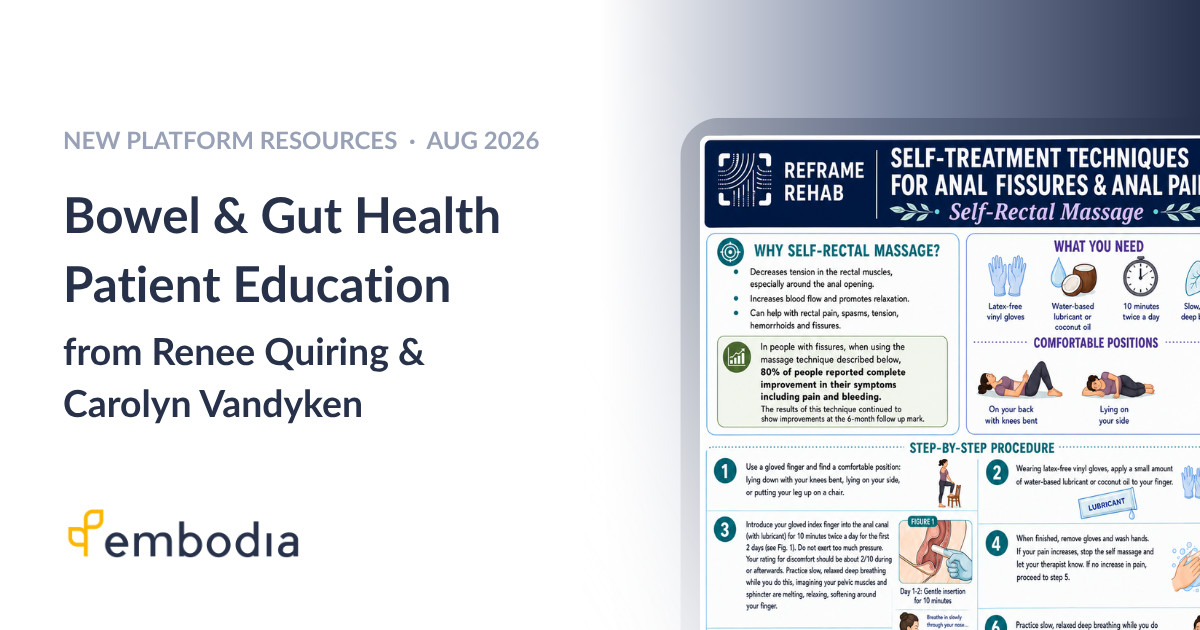
New Bowel & Gut Health Patient Education Collection by Carolyn Vandyken and Renee Quiring
Most patients will describe almost any other symptom before they'll describe their stool. So the questions that actually matter (Is this normal? Why does this keep happening? What am I supposed to do about it?) often go unasked in the clinic room, and get typed into a search bar instead, at home, alone.
That gap is what a new collection of bowel and gut health resources on Embodia is built to close. Created by Carolyn Vandyken and Renee Quiring of Reframe Rehab, the collection gives you nineteen patient education handouts covering everything from bloating and constipation to the gut-brain connection and pelvic-floor-related bowel symptoms, plus three new clinical assessment resources available exclusively to Year of Mentorship participants.
Who Are Carolyn Vandyken and Renee Quiring?
Carolyn Vandyken is the co-owner of Reframe Rehab and a pelvic health physiotherapist with 37 years of clinical experience spanning orthopaedics, pain science, and pelvic health. She leads Embodia's Year of Mentorship program and has built a reputation for translating complex, biopsychosocial concepts into language practitioners and patients can actually use.
Renee Quiring is a registered physiotherapist who moved into pelvic health in 2014 after years of practice in orthopaedics and neurorehabilitation. She now works as a lab assistant and mentor to other pelvic health physiotherapists, with a particular focus on how digestion, the nervous system, and the pelvic floor influence one another.
Together, they've built a collection that treats bowel health as what it actually is: a whole-body, whole-person issue, not just a plumbing problem.
What's in the Collection
The nineteen patient handouts are organized into four groups, so you can hand a patient exactly what's relevant to where they are in their care.
Understanding digestion, IBS, and common GI conditions
- Is It Bloating or Distension? Helps patients tell the difference between the feeling of bloating and the visible, measurable change of abdominal distension, and explains abdomino-phrenic dyssynergia (APD) in plain terms.
- Celiac Disease vs. Gluten Sensitivity: a side-by-side breakdown of two conditions patients frequently confuse.
How to Do an Elimination Challenge for Gluten Sensitivity: a step-by-step protocol, including the baseline testing step patients are most likely to skip. - IBS & Chronic Constipation: Understanding the Gut-Brain Connection: normalizes how common these conditions are and reframes them as a communication issue, not a structural one.
- Understanding Your Poop: the Bristol Stool Chart and a stool colour guide patients can actually reference.
- The Gut-Brain Axis Explained: a six-step visual walkthrough of how the brain and gut influence each other.
Nourishing and regulating the gut
- Feed Your Microbiome to Improve Gut Health: practical, food-first guidance on prebiotics, probiotics, and inflammation.
- Slow and Steady Wins the Race: Bowel Health Strategies: a 12-week framework for layering diet, microbiome, laxative, and supplement changes without overwhelming a patient.
- Laxatives: A Practical Guide to Bowel Relief: demystifies laxative types, onset times, and how to choose between them.
- Constipation Solved: 5 Strategies That Actually Work: five concrete levers patients can pull, from toilet posture to hydration targets.
The mind-gut connection
- How Our Emotional State Affects Our Gut: connects stress physiology, sleep, and GI symptoms in language that validates rather than dismisses.
- The Power of Breathing: five accessible breathing practices patients can use to shift out of fight-or-flight.
- Diaphragmatic Breathing for Abdomino-Phrenic Dyssynergia: three positions to retrain coordinated diaphragm and abdominal-wall movement.
- Self-Hypnosis for Irritable Bowel Syndrome: introduces gut-directed hypnotherapy as an evidence-based option for patients who haven't found relief through diet and lifestyle changes alone.
Hands-on & self-treatment for pelvic and anorectal symptoms
- Abdominal Wall Massage: the ILU massage technique, soft ball release, and ileocecal valve release.
- Anal Canal/Sphincter Problems: assessment considerations and self-management for fecal urgency, anal pain, and decreased muscle tone.
- Self-Treatment Techniques for Anal Fissures & Anal Pain, Using the Anurex® Tube: a full how-to, including safety parameters.
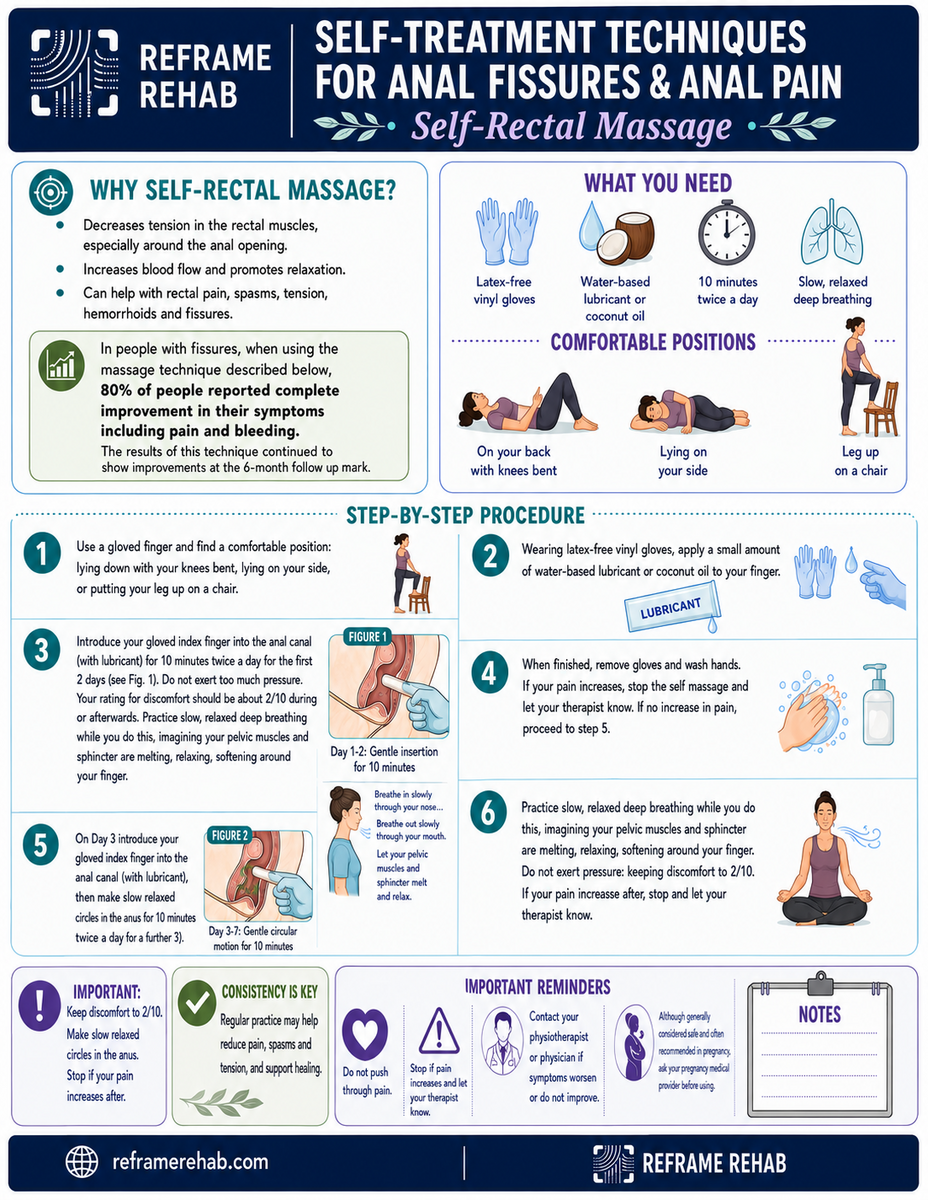
- Self-Treatment Techniques for Anal Fissures & Anal Pain, Self-Rectal Massage: a gentle, staged home protocol for rectal tension and fissures.
- Anorectal Balloon Catheter Training: a gentle, clinician-guided form of biofeedback that helps retrain bowel sensation and muscle coordination.
Here's an example of one of the pieces of new patient education:
New Clinical Assessment Resources for Year of Mentorship Participants
Alongside the patient-facing handouts, this collection also adds three resources built for you, not your patients: quick clinical references rather than handouts to share. These three are a Year of Mentorship benefit rather than part of the general patient education library, available to participants in Carolyn Vandyken's mentorship program (more on the program below).
Assessing IBS and Bowel Disease walks through the Rome V diagnostic criteria for IBS, how it differs from Rome IV, IBS subtyping using the Bristol Stool Form Scale, and the key differentiators between IBS and bowel diseases like Crohn's, ulcerative colitis, microscopic colitis, ischemic colitis, infectious colitis, and eosinophilic gastroenteritis.
Understanding Your GI Anatomy and Function covers GI tract anatomy and external surface mapping, key abdominal landmarks (McBurney's point, Lanz point, the transpyloric plane), GI valve locations, and the gastrocolic, enterogastric, and gastroileal reflexes that drive normal bowel function.
Understanding Gut Disorders organizes common GI conditions into motility disorders (GERD, achalasia, gastroparesis, dumping syndrome, intestinal pseudo-obstruction, fecal incontinence), malabsorption disorders (lactose intolerance, short bowel syndrome, bile acid malabsorption, SIBO, pancreatic insufficiency), and structural disorders (diverticular disease, gallstones, polyps, hernias, peptic ulcer disease, rectal prolapse, hemorrhoids, anal fissures).
Use these to sharpen your own clinical reasoning, refresh your differential before a complex bowel presentation, or orient a newer clinician on your team. They're reference material for Year of Mentorship participants, not content designed for patients to read.
Why the Whole-Person Approach Matters Here
Bowel symptoms are rarely just about the bowel. Stress changes gut motility. Poor sleep worsens visceral sensitivity. A patient who's been told for years that their symptoms are "just IBS" often arrives having stopped looking for an explanation at all.
That's why this collection consistently frames bowel and gut symptoms as the output of several interacting systems: diet, the microbiome, the nervous system, breathing mechanics, and pelvic floor coordination, rather than a single mechanical fault to fix. A patient who understands that stress and anal sphincter coordination are connected is a patient who can make sense of why the breathing exercise you gave them belongs in the same treatment plan as their laxative regimen.
For a topic patients are often too embarrassed to ask follow-up questions about, education they can read privately, at their own pace, does real clinical work.
How to Share These Resources with Your Patients
Embodia's Home Exercise Program (HEP) feature lets you prescribe exercises and share patient education from the same platform. Share a resource alongside an exercise program, or send it on its own. This is useful when you want to introduce a concept, like the gut-brain axis, before building on it at the next visit.
Sharing takes a few clicks: find the resource in the patient education library, click Share, and add a personal note if you'd like. Your patient receives it directly through the Embodia app or web platform to read at their own pace, or you can print it for patients who prefer paper.
Sharing patient education is included with Tier 2 (Patient engagement, $25/month) and Tier 3 (Practice management, $45/month) memberships. If you're on Tier 1 or a free account, you can upgrade at any time. Compare memberships on our pricing page.
Born Inside the Year of Mentorship
This collection grew out of Renee Quiring's session, How to Craft a Pleasurable Stool, held June 25, 2026, as part of Carolyn Vandyken's year-long mentorship program, My Year of Mentorship 2026: Building a Practical Pelvic Health Playbook. In it, Renee draws on her MSK, neuro, and pelvic health background to unpack how digestion affects the pelvic floor, and hands practitioners practical strategies for helping patients toward what she calls, memorably, a "pleasurable" stool.
The three clinical assessment resources above were built alongside this session and remain part of the program's materials, which is why they're available to Year of Mentorship participants rather than the general patient education library.
The program brings Carolyn and an international group of clinical and academic leaders in pelvic health together for sessions every other Thursday across the year, plus monthly office hours, a discussion forum, and case-study work with a lab partner.
The 2026 cohort is full and in-progress, but registration for the 2027 cohort opens later this year. Join the notification list here to get updates and early access when it does.
Keep Learning
- Carolyn Vandyken's Whole-Person Pelvic Health Patient Education
- Endometriosis Patient Education Resources for Your Clinic
If you're looking for clinical mentorship, get on the notification list for the 2027 cohort of My Year of Mentorship, led by Carolyn Vandyken and taught by an international group of clinical and academic leaders in pelvic health.
Frequently Asked Questions
Who are these resources for?
The nineteen patient handouts are written in plain language for patients, but designed for you to share. The three assessment resources are built for practitioners and are available exclusively to Year of Mentorship participants.
Do my patients need an IBS or bowel disease diagnosis to benefit?
No. Many of the resources, including those on bloating and distension, the gut-brain axis, breathing practices, and dietary strategies, are useful for patients still working toward a diagnosis, or whose symptoms don't fit neatly into one category.
How do I access and share the collection?
All nineteen patient handouts live in your Embodia patient education library and can be shared digitally through web or mobile, or printed. The three assessment resources are provided as part of the Year of Mentorship program's materials rather than the general patient education library.
Can I access the assessment resources if I'm not in the Year of Mentorship program?
No. They're offered as part of the program's session materials. The nineteen patient handouts, however, are available to all practitioners in the standard patient education library, regardless of Year of Mentorship enrollment.
Can I share these alongside exercise programs?
Yes. Share patient education through Embodia together with a patient's exercise program, so both live in one place your patient already knows how to find.
Is the self-hypnosis resource an endorsement of a specific app?
The self-hypnosis handout introduces gut-directed hypnotherapy as an evidence-based option and references a specific digital program as one way to access it. It's presented as one tool among many in the collection, not a replacement for the rest of your treatment plan.

BHScPT, Registered Physiotherapist
Graduated from the Mohawk/McMaster Physiotherapy program in 1988. Initially, she worked as a sole charge physiotherapist at Chapleau General Hospital in Northern Ontario. In 1993, she began working at the Canadian Back Institute in Kitchener/Cambridge, acquiring McKenzie A-C orthopaedic certificates. During this time, Renee had four children in six years. She decided to let her Physiotherapy license expire to stay home for ten years. After coaching cross-country, swimming and track and field and teaching at the high school level, Renee decided to return to Physiotherapy.
In 2010, she successfully completed the Physiotherapy National Exam on her first attempt. Renee began working in Neurorehabilitation and Pulmonary Rehabilitation at Freeport Hospital in Kitchener. In 2012, she obtained her Neurodevelopmental Theory certification. In 2014, Renee transitioned to Pelvic Health. Currently, she is a lab assistant and mentors other pelvic health physiotherapists. In her spare time, Renee enjoys running with her husband and spending time with her family.
BHSc (PT), CredMDT, CCMA
Carolyn is the co-owner of Reframe Rehab, a teaching company engaged in breaking down the barriers internationally between pelvic health, orthopaedics and pain science. Carolyn has practiced in orthopaedics and pelvic health for the past 37 years. She is a McKenzie Credentialled physiotherapist (1999), certified in acupuncture (2002), and obtained a certificate in Cognitive Behavioural Therapy (CBT) in 2017.
Carolyn received the YWCA Women of Distinction award (2004) and the distinguished Education Award from the OPA (2015). Carolyn was recently awarded the Medal of Distinction from the Canadian Physiotherapy Association in 2021 for her work in pelvic health and pain science.
Carolyn has been heavily involved in post-graduate pelvic health education, research in lumbopelvic pain, speaking at numerous international conferences and writing books and chapters for the past twenty years in pelvic health, orthopaedics and pain science.